
Last year, I read 13 books! This year I read 15. Still over my usual goal of 10 books per year. I also listened to a lot of podcasts, which I have included at the end of this list.
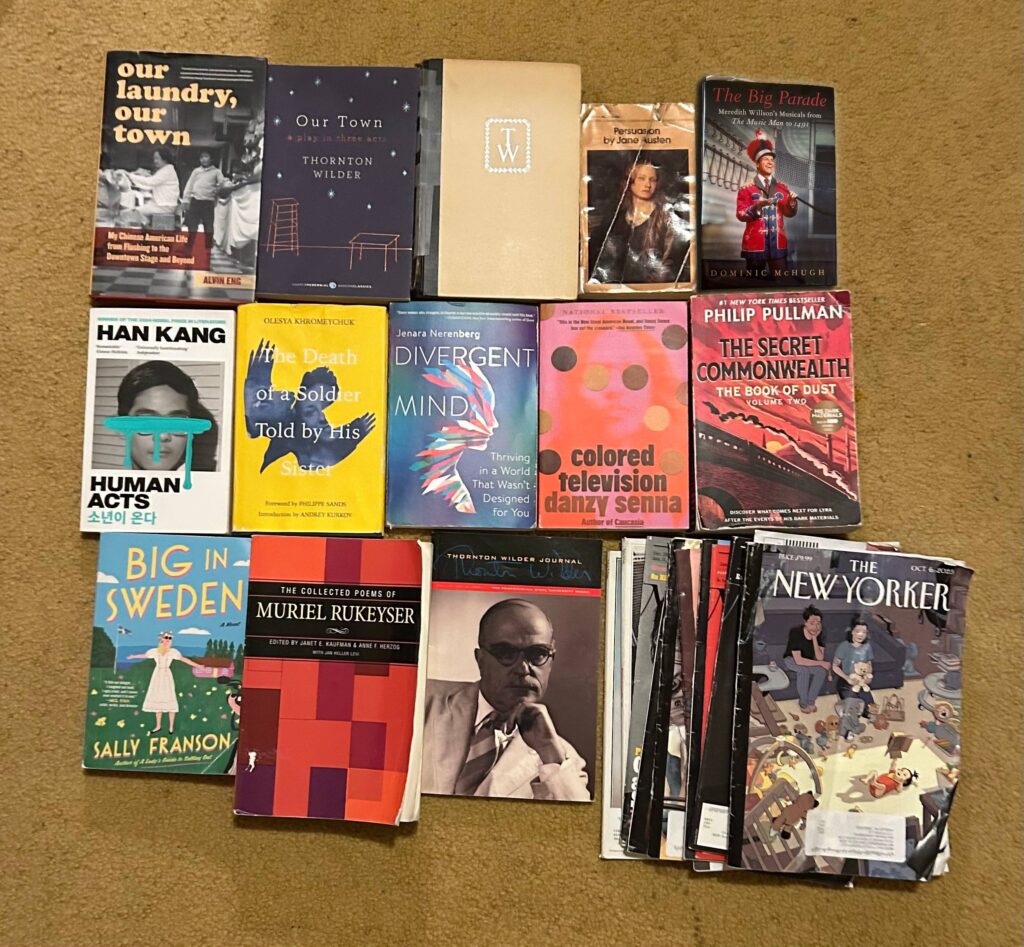
Stats:
7 fiction books (last year: 4)
Broken down into: 2 contemporary, 2 classic, and 1 part of a series, and 1 YA/childrens
1 of these was the second book in a trilogy; 3 were re-reads; 1 was by someone I know
6 non-fiction books (last year: 8)
Broken down into: 3 memoirs/autobiography, 2 academic/history, 1 psychology
3 were by someone I know
1 book of poetry (last year: 1)
1 play (last year: 0)
I read 5 non-American authors this year from the UK, South Korea, and Ukraine (though written in English as the author is based in the UK); last year it was 2. This year I read 9 female authors with 2 being a woman of color (I am counting the Thornton Wilder Journal as 1 female author); last year I read 8 female authors, with 2 being women of color. 6 books were for book clubs (last year it was 5): 1 of those was for the fiction book club at work (last year 2), 2 were for the ERG discussion groups at work (last year 2), 1 was a re-read for both the Thornton Wilder Society group (also 1 last year), and 1 was for the Barnard friends book group (0 last year). Usually I try to read at least one book by someone I know, and this year I read 4. Last year I read 1 books related to something I was writing/working on, and this year I read 2.
These stats are fairly similar to last year’s with slightly more fiction books and slightly fewer non-fiction books, but it’s pretty even. I kept my good mix of fiction, non-fiction, and poetry, including one theater book, which I did not read last year.
I also read 5 New Yorkers and 4 New York magazines, two and three less respectively from last year.
Goals:
Last year my goals were: “Make sure to read a theater book (I’m sure I’ll have no problem with that), continue to read memoir/autobiography but try to read an actual biography, read the next book in both series, read one book of poetry, re-read one Wilder fiction or play and one Wilder non-fiction. Continue to read more than half by women authors and have half of those be women of color, and half of your overall selections be authors of color. Read 7 New Yorkers and 7 New York Magazines again.”
I did so-so with these goals. I read the 1 theater book, continued to read memoir/autobiography books, 1 poetry book, and 3 Wilder books: fiction, non-fiction, and play. However, I also only read one of the next books in the series I had started (the Book of Dust series), but I had to skip the other (the Tree of Life series). I had had to skip the Book of Dust series last year, so this year I made the choice to read the 2nd book in that one and not finish the Tree of Life. I did not read a biography per se, but I did read autobiographies. I count those, but I’d like to get back to biographies again. 9/15 of the books were by women, which is definitely more than half, though only 2/9 were women of color, which is less than half. This was similar to last year. And I only read 5 New Yorkers and 5 New York magazines (and I’m still finishing those up, don’t tell anyone).
My goals for 2026 will be: Read a real estate book again, at least 1 Wilder fiction and 1 Wilder non-fiction, continue to read memoir/autobiography but try to read an actual biography, finish the Tree of Life series, read one book of poetry, and at least one theater book. Continue to read more than half by women authors and keep trying to have half of those be women of color, and half of your overall selections be authors of color. Read 7 New Yorkers and 7 New York Magazines again.
This year, I also did what I could of the online poetry course ModPo in the fall, which included listening to all the live webcasts and attending one in person. I also read two pilots this year.
My favorite book(s) of the year:
The Big Parade: Meredith Willson’s Musicals from The Music Man to 1491 by Dominic McHugh
Colored Television by Danzy Senna
And re-reads:
Our Town by Thornton Wilder
Tuck Everlasting by Natalie Babbitt (audiobook)
1. Our Laundry, Our Town by Alvin Eng
Our Laundry, Our Town is Eng’s memoir about growing up in Flushing in the 1960s and 1970s (before it was the Chinatown it is today) with the family’s laundry, then becoming a music journalist and publicist for the punk rock scene, and then entering the downtown theater scene and attending the Graduate Musical Theatre Writing program. The latter portion of the book is about Our Town, its influence on Eng’s life and work, including a project in China with students to create theater pieces inspired by the time capsule section of the play. The book had a lot of resonance for me, not just because of Thornton Wilder but because so much of what inspired Eng was a huge part of my life as well: the musical Tommy and Laurie Anderson being two examples. I also enjoyed learning how Chinese history and Chinese American history affected Eng’s family’s story, and I was brought back to my Chinese history class in college–it was over 20 years ago and we covered the entirety of Chinese history in one semester, so I don’t remember much, but certain events and phrases were familiar: The Cultural Revolution, The Great Leap Forward, the opium wars.
Finished: January 23, 2025
2. Our Town by Thornton Wilder
Reading Our Town again immediately after reading Eng’s Our Laundry, Our Town was a balm, especially this past week. The spirit world, the portal between life and death, it all feels very present right now. Our Town is such a rich text that I get something new out of it every time I read or see it. Now I’m thinking of it specifically in the context of this current moment and also in the context of its Chinese influences.
Finished: January 30, 2025
3. The Cabala by Thornton Wilder
I re-read Thornton Wilder’s first novel, The Cabala, for the Thornton Wilder Society Zoom reading and discussion series (basically a Thornton Wilder book/play club). I first read it 10 years ago, and at that point had only read a couple of Wilder’s novels: The Bridge of San Luis Rey and The Eighth Day. It did have some similarities to The Bridge of San Luis Rey but now that I have read all Wilder’s novels I realize it compares most to his final novel, Theophilus North. After the narrator meets the members of the Cabala, most of the chapters are him helping out various members with family members or unfortunate situations, which is what also happens in Theophilus North, though in Rhode Island, not Italy. I do like this book, even though it’s very much a first novel, but my big issue with it is that it functions like a television pilot. The last chapter is a big twist/reveal, which makes you go, OH MY GOD! I SEE WHAT’S GOING ON HERE! And it makes me want to watch the next episode. But there is no next episode. I won’t give anything else away, but if you are a fan of Wilder’s more well-known work, The Cabala is a great book to check out and understand his origins.
Finished: March 29, 2025
4. Persuasion by Jane Austen
I have to admit I’m not a huge Jane Austen fan, but I wanted to re-read this book for a book group discussing how the plot is the basis for a television show episodic arc. I read this book in college for an English class but had barely any memory of it. Upon re-reading I did remember a discussion in class about the opening chapters concerning the selling of the house, and I remembered how annoying I found those chapters both then and also now. I understand the need for that setup, but for me it takes so long to launch into the meat of the story. That said, I was not hugely into the meat of the story either. I don’t think I ever really cared about the characters, and part of the reason is that the setup of the story is two people who were once together are now no longer together and should be together, but we never really see them when they were together, so why should I care if they get back together? The television episode arc we were comparing it to fixes this by having us spend time with them as they are coming together initially and then seeing them together for a bit. I also don’t love Jane Austen’s writing style, though I got a bit more used to it as the book went on. I remember having a similar issue when I read Pride and Prejudice in high school–that it was boring until the last 10 pages when they finally get together. Still, I feel like Jane Austen novels are important to read even if I find them a slog because people borrow so many plots from them. They’re like Shakespeare in that way. I suppose I should read more of them, but it would only be worthwhile in this similar book club format where we are comparing them to their adaptations.
Finished: March 31, 2025
5. Leading Lady: A Memoir of a Most Unusual Boy by Charles Busch (audiobook)
Charles Busch is one of my favorite theater artist, and I’m so glad I listened to him read the audiobook version, though I did miss out on all the photos. In general it was great in contextualizing his plays and collaborators, like when certain key players came into his life and how. And there are some really poignant sections, and of course chapters on his Broadway shows The Tale of the Allergist Wife and Taboo. I keep forgetting he wrote the book for Taboo. The Tale of the Allergist Wife was my introduction to him, and that play bowled me over when I saw it. I then got to work with him on his play Olive and the Bitter Herbs at Primary Stages in 2011 (not mentioned at all in the book). I wrote the copy for the marketing blurb, which he loved, and interviewed him in his home for our video interview series. It was a wonderful experience, and around that time I also read his book of published plays, and saw many of his other plays over the years. I love artist memoirs because I’m always fascinated by how artists become artists, and I’m so glad this memoir exists. He’s had such a fascinating career.
Finished: April 7, 2025
6. The Big Parade: Meredith Willson’s Musicals from The Music Man to 1491 by Dominic McHugh
I enjoyed The Big Parade’s look at Meredith Willson’s work as a whole, though it understandably focuses most on The Music Man. Apparently Willson’s mentor, the musical theater writer Frank Loesser, was always telling Willson to keep writing more musicals to establish a body of work and therefor legacy and footprint in musical theater. Willson attempted this by writing and producing three more musicals, however he’s still really only known as the writer of The Music Man. The Music Man chapters were the most interesting to me because I know that show best out of all his works, and also I know it very well. Areas I found most fascinating were the development and then jettisoning of the disability plot (there was a young character with a physical disability that eventually became Winthrop, covered in an article) and, on a smaller scale, the development of the song “My White Knight,” which used to be more of a soliloquy (Barbara Cook sings the original version on a Carnegie Hall concert album). It was a bit more difficult to read the chapters on The Unsinkable Molly Brown, Here’s Love, and 1491, though I have seen The Unsinkable Molly Brown, I just don’t remember it very well (and the version I saw in early 2020 was a revised version). Others have had similar reactions to the show, so while it was successful, it was not a huge hit and does not loom very large in musical theater history. I know and love one song from Here’s Love, “Love, Come Take Me Again,” which was actually cut when the show reached Broadway and was later reinstated, so it’s not even on the cast recording. But otherwise I don’t know that show and have never even seen the film it’s based on (Miracle on 34th Street). And no one has seen 1491 (well, very few), a show about Christopher Columbus the year before he embarked on his voyage, as it closed out of town before even reaching Broadway. Fortunately, Robert W. Schneider’s wonderful podcast Broadway Bound covered the show right as I was about to read that chapter, so I was able to hear more about it and listen to some of the songs as supplemental material. The Big Parade is very much worth reading if you are a Music Man fan (I refer to it as my favorite musical when asked) as it puts that show in the context of Willson’s life and career (he worked very successfully in classical music and radio before turning to musical theater in his 50s–I guess today we would look at him as a sort of Sara Bareilles, someone who’s worked in an adjacent field all their lives and everyone is like, you should write a musical, come write a musical! And the result is actually good and successful). I still wonder about the push for Willson to write more musicals to build a legacy. I get that idea (I hear it all the time today), but I also wonder about what would have happened if he did not and instead went and did something else. Would anyone miss The Unsinkable Molly Brown and the others? Probably not. Or maybe someone else would have written them better. Maybe some people do have one good musical in them and then a bunch of other non-musical theater things. Or maybe he didn’t have the right collaborators on those projects and the right circumstances. With musical theater, one can speculate forever.
Finished: May 9, 2025
7. Human Acts by Han Kang
When Human Acts came up as the next book for my company book club, I saw that it was about the Gwangju Uprising in South Korea in 1980. I had heard about this uprising, but I didn’t really know any details, so I jumped at the chance to read this book to learn more. I loved how this book was about the people affected and not the perpetrators. There is a tiny bit about the perpetrators at the end, but mostly this book focuses on the people who were either killed or had to live with the trauma of that horrific event. Each chapter is about a character, and the first chapter introduces us to the focal point of the story: a middle schooler (who is 15 years old) who is part of a group cleaning up the bodies while the uprising continues. Each character we meet has some connection to the boy. This book is about violence–I think each chapter starts with a description of some act of violence, even just someone being slapped on the cheek so much so that they draw blood. This book is also about how a major traumatic political event doesn’t just end but affects people and countries for many years after. It made me think about the political violence in other countries, including my own, and how it’s not only happening but could get much worse, to the point of a massacre such as this one.
Finished: July 24, 2025
8. The Death of a Soldier Told By His Sister by Olesya Khromeychuk
This is a beautiful book by the sister of a soldier who died in Ukraine, not in the current war but in the conflict before it, which I knew nothing about. I love Olesya Khromeychuk’s writing, she brings out all these little details as she attempts to convey the complicated life of her brother and also to convey the tragedy and emotions of war. And though the thoughts are complex, the writing is very accessible. I also enjoyed that she was a theater artist as well as a writer and made a theater piece about her brother. While I haven’t lost a close family member in war or otherwise, I related to that impetus to create a theater piece to wrestle with complex and emotional experiences. I read this book for a discussion group at work, and it was also helpful to digest the book with others.
Finished: July 29, 2025
9. Divergent Mind: Thriving in a World That Wasn’t Designed for You by Jenara Nerenberg
I read this book for a discussion group at my company, and it was a great book to generate discussions on being neurodivergent in the workplace. I knew going in that this would be a book for the discussion experience, not really for the reading experience. It is really more like a long article that’s been unneccessarily expanded and still just basically saying, “this is a thing.” “This,” being that many women are not diagnosed with a neurodivergence until later in life, after they realize that something is not right and/or they burnout from trying to thrive in an world that wasn’t designed for them. In many ways, I related, but I also knew the book was only focusing on a small segment of people with ADHD, autism, sensory processing disorder (SPD), and synesthesia, a segment that can adapt and achieve until suddenly they can’t. This was all good fodder for discussion but I don’t think I would have read this book without that discussion group built into it.
Finished: August 1, 2025
10. Colored Television by Danzy Senna
This was a book I picked up while I was in Montreal and started as a “vacation book.” I ended up really loving this book even though I was unsure about it for most of the middle section. Once the main character, Jane, pivoted desperately from novels to television and her storyline was based on whether she would get away with her lies, I was less invested, even though I was still enjoying the writing itself. However as the book wrapped up, it became less about the lies and more about her character and how she was going to deal with her flaws and trauma (although trauma may not be the right word) from growing up. Her vision for her ideal life was starting to ruin her, and even though I don’t have the same vision for an ideal life, I realized while reading it that I do have a vision for my own ideal life, and this book made me interrogate my relationship with that vision. I found the resolution very satisfying, as it seemed very true to life, authentic, and, in its own way, happy. My only wish is that I could have seen more clues that there was love between her and her husband, even though the relationship was often rocky. I just wanted to root for them a tiny bit more. But I always love reading books about writers and artists, so the subject matter, combined with the strong writing, made this a great book to zip through in the last month of summer. There’s a lot more to this book, but when I found myself explaining this book the other day I found I couldn’t quite describe it in a way that encapsulated everything. It’s also about race, about class, about being a writer in academia, about being a working mom, about the television industry–there’s a lot packed in.
Finished: September 2, 2025
11. Tuck Everlastingby Natalie Babbitt (audiobook)
I realized a couple weeks ago that this year (2025) is the 50th anniversary of my favorite book, Tuck Everlasting, and that there was a new audiobook being released, read by the actress from the 2002 movie Alexis Bledel. I’ve been re-reading this book every 10 years or so, revisiting it in the same interval that the Tucks come together again in Treegap (at least until the events of the story), and the last time I read it was in 2016, the year I saw the beautiful musical version, so I figured it was the perfect time to do my re-read. I don’t usually like listening to fiction audiobooks because it’s hard for me to follow the story, but I can do it if I’ve read the book multiple times. And it was so nice to experience my favorite book in this new way. Gabrielle Zevin (author of Tomorrow, and Tomorrow, and Tomorrow) wrote a new introduction about her history with the book and her love for it, which set the book up well, and I don’t think I’ve ever loved Alexis Bledel more than hearing her read this story (and I enjoyed her in Gilmore Girls). You could feel her love for the material in her voice. She acted some of the lines but not with any ostentatiousness; it was all perfect for the world.
Tuck Everlasting made me want to be a writer when I first read it in my second grade classroom. Every word, every line, every moment stuck with me and influenced how I see the world, especially the famous first line: “The first week of August hangs at the very top of summer, the top of the live-long year, like the highest seat of a Ferris wheel when it pauses in its turning.” From this, I came to view time as a circle, like a wheel. I almost wish this 50th anniversary book/audiobook came out the first week of August instead of the first week of September. This is, among many things, a book about August.
But most importantly, there’s Winnie’s line: “I’m not exactly sure what I’d do, you know, but something interesting– something that’s all mine. Something that would make some kind of difference in the world.” I know when I first read that line at age 7 I was thinking, yes, that’s me, this book and this character is me.
So much more stood out to me on this read, most notably how the Tucks are treated and referred to as simple, uneducated folks, and there’s an unspoken or barely spoken mentality from the richer townsfolk of, why would these people get to live forever when they’re barely worthy of any life at all? But they are the ones to get it and they are the ones to teach us, well, Winnie specifically in this book, but also me at 7 years old and every year since, about the value of life but also the value of death.
I can’t wait to revisit this book again in another 10 or so years.
Finished: September 5, 2025
12. The Book of Dust Volume Two: The Secret Commonwealth by Philip Pullman
I enjoyed being back in the His Dark Materials world with this book, the second book in the second trilogy called The Book of Dust. Second parts of a trilogy are difficult, but I really loved the second part of the first His Dark Materials trilogy, The Subtle Knife. I wish I could have loved The Secret Commonwealth. I was glad to have Lyra back as a non-baby (she was a baby in the first book of this series), and it was great to see her now as an older person, age 20, but I really missed not having any kids in a book for the first time. While we didn’t really have Lyra in the first book, we did have pre-teen Malcolm and teenage Alice, and that felt like a nice balance. For some reason it helps for the events in these series to be experienced by a young person; maybe because there should be someone still connected to what this book calls The Secret Commonwealth, or, all the magical stuff. The conflict in this book centers on Lyra having lost her imagination, or her belief in the world’s magic. She does find some of it, but it’s still not the same as having a young person just live it.
It was also difficult to track so many characters moving around the globe each on a separate path. The book started with a nice build, but then all the characters disperse. I would have liked to have picked one character to follow, with one or two divergences now and then, but it was too much whiplash every time I switched to another character. Where were they? What was going on? The last third of the book just felt like a series of events with little build.
Plus, with Lyra now traveling without Pan, she was mostly an internal character. Even when she interacted with people along the way, she reacted to everything internally. That’s always fine in a novel, of course, but I think she operates better in dialogue because everything felt slowed down. I really wish they would have given her a travel companion on her adventures. Either her friend/ex Dick Orchard or the school friend from the very beginning, Miriam Jacobs, whose father’s business is ruined. My pick would be Miriam as it would have been nice to see Lyra have a girl friend and Miriam also seems like a character who could grow from being a bit superficial to someone with more integrity. Also, she’s most likely Jewish given her name, and it would be nice to follow a Jewish character in this very Christian (or anti-Christian) world.
Lastly, I had hoped this book would have an ending. I enjoyed that the first book in this series was self-contained, had a climax, and then closed the door on that moment in time, only for the second book to pick up 20 years later. About 100 pages from the end I realized we were nowhere near any climax and that, sadly, there wouldn’t be one. With the book over 600 pages, it’s difficult to have it just end, only to be concluded later with another 600 page book. I was hoping the third book would also have a time jump. Oh well.
But again, I really enjoyed being back in this world, especially because there was more insight into my favorite character, Marisa Coulter. Though she has been long dead, she still felt very present in the form of her family members. I continue to love Lyra, even though she’s in a funk, and I really enjoyed all the deeper details about daemons, probably the coolest concept to come out of these books.
Finished: November 6, 2025
13. Big in Sweden by Sally Franson
I read this both for my college friends book club and because I went to college with the author, so I have read both her books now. The story is about a woman in her mid-30s who goes on a Swedish reality show about reconnecting with their Swedish ancestry and families, but I was less interested in the reality show aspect of it than I was in her relationship with her partner and her life back home. I’m generally not interested in reality TV, but I also wonder if a behind the scenes look at reality TV is better suited to the television format, like the television show UnReal, since that’s what it’s commenting on. But I enjoyed following Paulie, the main character with a f*cked-up family history, as she searched for some form of family in her ancestral land, whether it was with her fellow contestants that she finds reasons to love even though she disagrees with them and they annoy her in many ways, the hot crew member she’s attracted to, or her actual family still in Sweden. In a way it also reminded me of the film Midsommar– dealing with trauma in Sweden and finding new family. The one aspect of the book that made me a little uncomfortable was that she is at first at odds with many of the contestants that voted for a person she can’t stand (not named, but pretty obvious who), and yet a major part of her journey is finding she has a lot more in common with them than she thought and she finds she loves them at the end. I wasn’t sure what the book was saying about these relationships because, yeah, anyone can find common ground with anyone else, and it’s easy to focus on that and find love for them if you don’t have any hard conversations. Or maybe it was just a bit of Stockholm Syndrome being cooped up with them for the duration of the filming. The ending also felt tied up in too neat a bow for me, but I was glad to return to her partner and real family, as well as her therapy group, where she was forced to confront her experience in Sweden. I would have liked more time there with them.
Finished: December 1, 2025
14. Body of Waking by Muriel Rukeyser
There were so many different types of poems to enjoy in this collection, but they were all around the theme of waking and being born in some way. By the end I started thinking more about what happens if we substitute the idea of waking up in the morning or waking up to an idea/concept or even the term “woke” with the idea of being born, as some of the poems had this overlap. There were some poems that I loved just as a short, concrete poem and others that were long and winding. The titular poem “Body of Waking” is one of the latter, and I would love to read and discuss it in a group setting. Then the Suite for Lord Timothy Dexter, which goes with a different series of poems about people’s lives, is fun and playful. There’s also a series of translations of Octavio Paz poems. An eclectic collection while still thematic, and I kept thinking about the resonances with her next collection, which I’m excited to start next year and which contains my favorite poem of hers, “Speed of Darkness.” I have been reading one book a year of Muriel Rukeyser poetry from The Collected Poems since 2019.
Finished: December 6, 2025
15. The Thornton Wilder Journal: Volume 2, Number 2 edited by Jackson R. Bryer, Mary C. English, Lincoln Konkle, Edyta Oczkowicz, and Terryl W. Hallquist
I finished reading an issue of the Thornton Wilder Journal from 2021 as I slowly make my way through them. This edition had fascinating articles on The Emporium (which I’ll be writing about in the spring so it was great to get a head start on it), the Italian introductions to Wilder’s work in translation during the Italy’s fascist period, and Hitchcock and Wilder’s film Shadow of a Doubt, as well as articles from topics I heard discussed way back at the 2018 Wilder conference. There were also various theater reviews of productions I had seen (Magis Theatre Company’s The Alcestiad) and ones I was not able to see. I’m so glad we have these in depth reviews from 2021 when theaters were just opening up again and doing creative productions outdoors and virtually. What theaters were able to do during these times runs the risk of being forgotten. And as I put the finishing touches on my own review of The Seat of Our Pants for the next Thornton Wilder Journal, it was helpful to read other reviews.
Finished: December 23, 2025
Screenplays/Pilots:
Pen 15 pilot
Brooklyn 99 pilot
Online Classes:
ModPo, 12th Year (University of Pennsylvania)
Podcasts (listened to all or most episodes)
Scene to Song
Moonlighting the Podcast
On the Nose: A Jewish Currents Podcast
Awaken
Disney Inside Out/Grown-Ass Kids Club Podcast
The Hitchcock Gays
Broadway Bound: The Musicals That Never Came to Broadway
Putting it Together
Scriptnotes
Act Two Podcast
Matching Minds with Sondheim
The Devil You Know with Sarah Marshall
The Little Things You Hear Together with Alex Asp
And Episodes of:
You Are Good, The Slowdown with Maggie Smith, Thesis on Joan, Maintenance Phase, You’re Wrong About, Broadway Breakdown, Know the Show, A Musical Theatre Podcast, Where Should We Begin? with Esther Perel, Superhero Ethics, 5-4, Broadway Nation, Little Known Facts, Millennials are Killing Capitalism, Muppeturgy, Decoder Ring, This Ends at Prom, The Wrong Cat Died, The Writers Panel, Broadway Vocal Coach, Blank Check with Griffin and David, Middling with Eden and Brock, Backstage Pass, Lingthusiasm, The Hollywood Hang, Strong Songs, Restaurant People, Sounding Cinema, Flights & Tights: A Superman Movie Podcast, Daughters of Lorraine, Giants in the Sky, Scripts & Scribes
One Episode of:
Survival Jobs: A Podcast, Dr. Berlin’s Informed Pregnancy Podcast, The Cheese Wheel, Regrets I’ve Had a Few, Freakanomics Radio, Watch No Evil, Circle This, Feel Better Live More, Sustainable Ambition, The Originals